
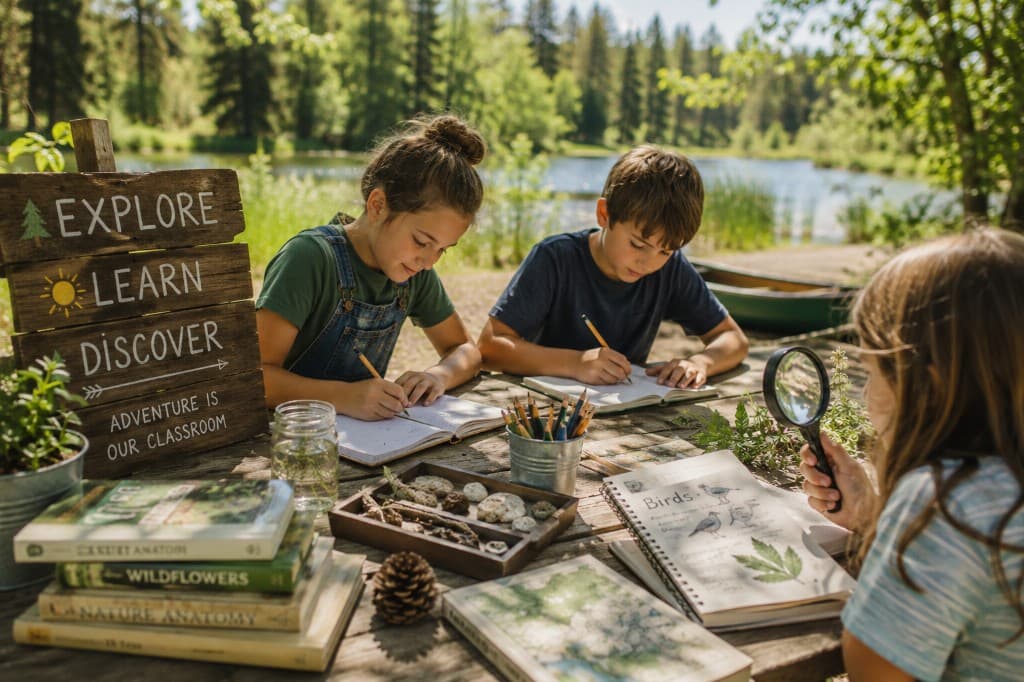
When summer arrives, many homeschooling families face a familiar question: Should we keep homeschooling, or should we take the summer off?
There is no single correct answer. My family continues with a lighter version of our regular routine. Others close the books completely for several weeks. Many fall somewhere in between, setting aside formal lessons while remaining open to the learning that naturally happens during summer.
That middle path can be especially valuable. Summer does not have to become another tightly scheduled school term, but learning does not need to stop either. In fact, summer may offer some of the richest opportunities for children to learn through experience, curiosity, responsibility, and play.
Summer Learning Does Not Have to Look Like School
When people hear the word “homeschooling,” they often picture textbooks, worksheets, lessons, and assignments. Those things can certainly have a place, but education is much broader than formal academic work.
A child who plans a camping trip is using research, geography, budgeting, organization, and problem-solving. A teenager who prepares meals for the family is practising measurement, nutrition, time management, and practical life skills. A child building a fort is experimenting with design, structure, balance, and engineering.
Summer makes this kind of learning easier to notice because children often have more uninterrupted time. They can become absorbed in a project, explore a question, or develop a skill without having to stop because the next lesson is scheduled to begin.
Instead of asking, “How will we keep up with school this summer?” it may be more helpful to ask, “What kinds of learning does this season make possible?”
Follow Interests and Curiosity
Summer is an excellent time to let children pursue subjects that interest them but do not always fit neatly into the regular homeschool schedule.
One child might want to learn about birds, insects, weather, gardening, or local history. Another might become interested in photography, animation, sewing, carpentry, coding, music, or baking. A teenager might want to start a small business, volunteer, prepare for a future course, or learn how to repair a bicycle.
These interests can develop into meaningful projects without needing to be turned into formal units. A child interested in birds might borrow a field guide, identify local species, photograph nests, keep a nature journal, or build a birdhouse. A child interested in baking might compare recipes, calculate ingredient costs, explore the chemistry of yeast, and prepare food for a community event.
Parents can support these interests by providing materials, transportation, encouragement, and helpful questions. They do not necessarily need to design a complete curriculum.
Take Learning Outdoors
Summer expands the classroom.
Parks, trails, gardens, farms, museums, historic sites, festivals, lakes, and campgrounds can all become places of learning. Even an ordinary walk through the neighbourhood can lead to conversations about plants, architecture, insects, weather, municipal planning, or local businesses.
Outdoor learning can be intentional without becoming complicated. A family might choose a new trail each week, visit several provincial parks, grow a small garden, study the night sky, or create a list of local places to explore.
Children can help plan these outings. They can look at maps, estimate travel time, check the weather, prepare supplies, calculate costs, and research the destination. These tasks provide authentic reasons to read, write, calculate, and organize information.
The experience itself is only part of the learning. Children may also draw what they saw, create a photo album, write a review, make a map, compare locations, or tell relatives about the trip.
Make Room for Practical Life Skills
Summer can also provide time for children to participate more fully in family and community life.
They can help with gardening, cooking, grocery shopping, home repairs, pet care, childcare, household organization, or planning family activities. Older children may take on paid work, volunteer positions, entrepreneurial projects, or greater responsibility around the home.
These experiences teach skills that are difficult to reproduce in a workbook. Children learn that their work matters. They experience the consequences of forgetting something, the satisfaction of completing a useful task, and the challenge of working with other people.
Practical responsibilities also help children develop confidence. A child who learns to prepare lunch, navigate a bus route, organize equipment for an outing, or speak to a store employee is gradually becoming more capable and independent.
Keep a Small Amount of Structure Where It Helps
Although summer can be relaxed, some children benefit from maintaining a little structure. This is particularly true when they are developing a skill that requires regular practice.
A simple summer routine might include daily reading, music practice, a few math problems, journaling, or working on one ongoing project. The goal does not need to be covering a large amount of material. It may simply be maintaining confidence and continuity.
A family could create a short morning routine and leave the rest of the day open. For example, children might read for twenty minutes, complete one household responsibility, and spend a little time on a personal goal before moving into free play or other activities.
The routine should support the family rather than dominate the season. If it causes constant conflict or prevents children from participating in worthwhile experiences, it may need to be simplified.
Protect Time for Rest and Boredom
Rest is not the opposite of learning.
Children need time to recover from demanding schedules, physical growth, social pressures, and concentrated academic work. They also need unstructured time in which nobody is telling them what to do.
Boredom can be uncomfortable, but it often precedes creativity. When entertainment and adult direction are not immediately available, children may invent games, build things, read, draw, explore, daydream, or begin projects of their own.
Parents do not have to fill every summer afternoon with lessons, camps, outings, or enrichment activities. A quiet day at home can be valuable. So can an afternoon spent talking with friends, lying in the grass, playing a long game, or reading an entire book.
Document Summer Learning Lightly
Families who need or want to keep records can document summer learning without turning every experience into an assignment.
A few photographs, brief notes, project samples, book lists, or journal entries may be enough. Parents might record a sentence or two about an outing, practical skill, conversation, or project and connect it to broader areas of learning later.
For example, gardening may include biology, environmental science, measurement, nutrition, and responsibility. Planning a road trip may involve geography, mathematics, research, budgeting, and communication.
The purpose of documentation is to make learning visible, not to interrupt it.
Let Summer Have Its Own Character
Summer homeschooling does not need to imitate the rest of the year. It can be more physical, social, practical, spontaneous, and connected to the outdoors.
Some families may continue formal studies because that rhythm works well for them. Others may need a complete break. Many will create a flexible combination of rest, projects, reading, outings, and daily life.
The most important thing is not whether summer “counts” as school. It is recognizing that children continue to learn wherever they are.
Summer offers time to explore, contribute, practise independence, deepen interests, and experience the world beyond a lesson plan. When we broaden our understanding of education, we may discover that taking a break from formal schooling does not mean taking a break from learning at all.
— Monica Truong